

who should decide what science gets funded?
NASA, peer review, and the politics of discovery

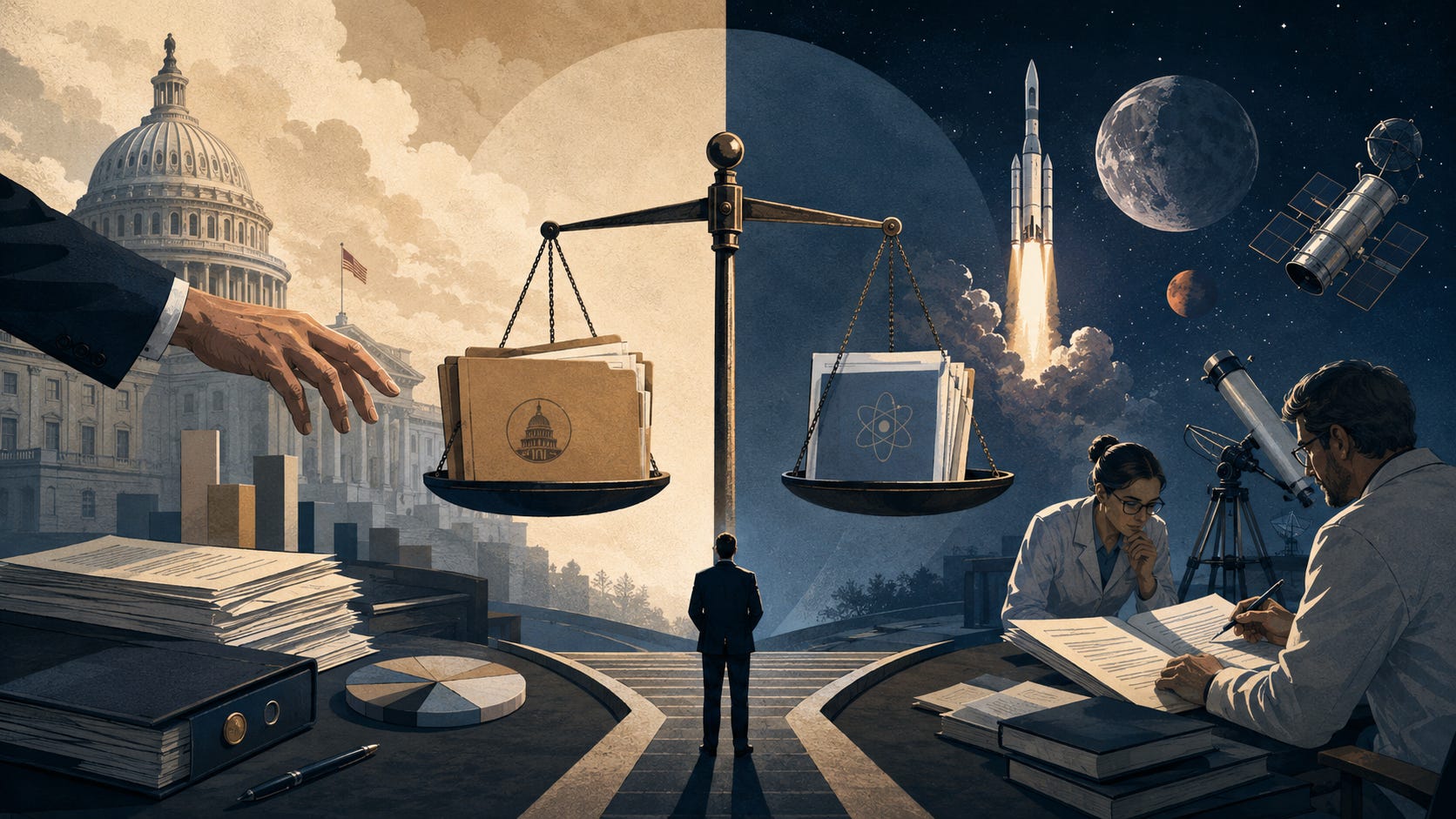
Money is always an awkward subject, whether between friends, partners, or governments. But with high deficits and debt, both political parties in the US are under immense pressure to curb spending. Funding for scientific research is a central part of that debate. It is reasonable for elected officials to ask what the federal government should fund, how much it should spend, and how to ensure accountability afterward. The current NASA budget debate raises a separate question, related to but distinct from spending: once Congress sets broad priorities and spending levels, who should judge the scientific merit of specific research?
In what began as a hopeful year for the space community, with the success of Artemis II and renewed public interest in the program, the White House announced a 23% cut to NASA’s FY27 budget, from $24.4 billion to $18.8 billion. Civil society groups like the Planetary Society have called this an existential threat to space science. The current NASA budget debate and proposed changes to federal grant oversight illustrate that science policy involves two distinct decisions: how much governments should spend on science, and who should decide which science gets funded. Liberal democracies have good reasons to treat those questions differently.
While the full House and Senate are yet to vote, the House Appropriations Committee has rejected the proposed cut and advanced its own bill, approving the initial $24.4 billion. However, its proposal still cuts NASA’s Science Mission Directorate by about 17 percent, from $7.25 billion to $6.0 billion. NASA has had budget cuts before, and not every budget cut has been bad. In the Cold War space race era, almost a third of NASA’s budget went to the Apollo missions. But after 1972, NASA ended its lunar landing program and shifted toward the Space Shuttle era, as post-Apollo plans for sustained lunar infrastructure and eventual Mars missions failed to secure political support. Exploration was mostly state-directed, and commercialization did not exist in its current form. With the Vietnam War raging and the Apollo missions eating up much of NASA’s budget, public support waned as more moon landings didn’t generate the same curiosity as Apollo 11.
One can believe a scientific project is valuable and still recognize that governments operate under constraints, as Apollo’s history shows. Even if a scientist believes it is worth spending more on a discovery or invention that could change the world, the idea can still fail if it does not fit within the political or cultural zeitgeist. Despite a shift in the political zeitgeist of the post-Apollo era, the scientific community was still enthusiastic about lunar exploration. Then-NASA Administrator Tom Paine laid out a vision complete with lunar bases, orbital stations, and eventually, missions to Mars. The technological vision was enticing, but the politics were not.
The question of which scientific projects should get funded has no straightforward objective answer. The most common way to determine the value of a scientific project is to measure its economic return. But that is reductive. Sometimes, a project has commercial applications. Other times, it has public safety, environmental, or security applications. In some cases, it may expand scientific knowledge without any obvious immediate use, like planetary science missions that study other worlds. A project can also build institutional capabilities such as better-trained scientists, advanced equipment, stronger universities, testing infrastructure, and technical competence. The Apollo missions did not just put astronauts on the Moon. They helped build the foundations for NASA’s other space successes. This does not mean every proposal deserves funding. Public funding for science must be evaluated with a broader understanding of scientific value than short-term commercial gains or political visibility.
Budget restructuring is a routine part of democratic politics, but the deeper concern goes beyond NASA’s top-line budget. One part of the OMB’s proposed “Regulation for Federal Financial Assistance” would require senior appointees to conduct pre-issuance review of discretionary awards. Section 200.205 of the regulation says that appointees “must not ministerially ratify or routinely defer to the recommendations of others, but must instead use their independent judgment when evaluating Federal award proposals,” increasing the risk of politicizing grant decisions.
A government’s basic job is to set national priorities. To ensure that it maintains its competitive edge in science policy, the US needs baseline rules that separate political priority-setting from scientific judgment. Elected officials should decide broad goals, the scientific community should evaluate merit, and markets should commercialize opportunities where voluntary exchange can work. This division of labor is the closest thing science policy has to checks and balances.
If the entire research enterprise were based on the Haldane Principle, where governments would simply provide the money and scientists would decide what to do with it, science policy literature would be very different. Treating the Haldane Principle as an absolute rule would be wrong. But its basic premise is compelling. Governments should set broad priorities and determine the level of public spending. Scientists should have autonomy in judging scientific merit within those priorities. Separating politics and science, though ideal, is almost impossible in a democracy. But it is possible to draw a line: political accountability should function at the level of goal-setting and budgets, not individual grant decisions.
In liberal democracies, where there is a tension between autonomy to explore and accountability, not least because of political polarization, the solution is more complex. In space policy, markets tend to work better to discover new applications, reduce costs, and scale technologies once uncertainty falls. NASA’s 2006 Commercial Orbital Transportation Services program is a useful example. Under the initiative, NASA partnered with private companies in developing and demonstrating commercial cargo delivery spacecraft for the International Space Station (ISS).
NASA may be better positioned to fund research whose benefits are diffuse, long-term, and difficult to appropriate. Liberal democracies face a harder problem than technocracies or centralized states. They cannot simply hand science policy to experts, because public money requires democratic accountability. They also should not let elected officials treat research funding as another way to weaponize partisan differences. The task is to protect three things at once: democratic control over public money, expert judgment over scientific merit, and enough insulation from short-term politics for risky research to survive.
The pre-issuance rule crosses that line by moving toward individual grant decisions and away from general priority-setting. The regulation does not merely relegate peer review to advisory status. It also gives independent political judgment the power to override peer review on a case-by-case basis. The regulation equips political institutions to do something that they are not designed to do in isolation—adjudicate scientific merit.
Space is not the only field where these tensions appear. NASA’s case is a helpful example because it combines science, technological development, national prestige, institutional economics, and geopolitical competition. That makes the current budget and grant-review debate more than a fight over one agency or industry. It is a case study in how liberal democracies govern science in strategic sectors. To help make more sense of the problem, it is useful to draw insights from Vannevar Bush, Michael Polanyi, and the intellectual tradition of public choice.
In one of the most important works of the post-World War II era, Science, the Endless Frontier (1945), Vannevar Bush made an argument that is still relevant to how governments and the scientific community interact. While the government’s job is to build research infrastructure, it is universities and research organizations that do the innovating. Despite tensions between President Eisenhower and a Democratic-controlled Congress after the launch of Sputnik, there was a bipartisan consensus that NASA’s creation would be a force for good. On the other hand, the Soviet Union engaged in political favoritism and bureaucratic infighting. Despite initial victories in the space race, the rivalry between chief designers Sergei Korolev and Vladimir Chelomei ultimately cast a shadow over the Soviets’ lunar ambitions. For research projects that involve long time horizons, state support can be helpful, with limits.
In his classic 1962 essay, “The Republic of Science,” Michael Polanyi discusses how the scientific community is organized such that the research process is decentralized. Rather than through centralized command, scientific inquiry emerges as expert scientists review each other’s theories—which is analogous, though not identical, to how Adam Smith’s invisible hand works.
The Buchanan-Tullock tradition of public choice adds another layer by assuming that different actors have different, often clashing incentives. Politicians may seek re-election, want big results with little spending, and work over short time horizons. Scientists may be motivated by intellectual curiosity, but they also compete for funding, prestige, and intellectual freedom, and often prefer projects with long time horizons. University administrations may want more federal grants, a larger institutional reach, and high rankings. Finally, firms may want larger profits, patents and intellectual property protections, and diverse business opportunities. When funding criteria become volatile, researchers and universities may rationally shift toward research they perceive as more fundable. This is not the same as overt censorship, but it does gradually narrow the field of inquiry before ideas are given room to be tested.
Peer review processes are not always flawless. Some researchers may want to protect the mainstream academic consensus on a topic or may reward people in their network. However, peer review is still within the scientific community and, through open criticism and replication, can be corrected. In other words, failures of peer review are internal to scientific contestation, while political review introduces a different and more complex incentive structure. This raises the question: What kind of arrangement best reconciles these incentives with the honest pursuit of scientific discovery?
There is no panacea, but the first step lies in understanding what each actor is best equipped to do. No single institution possesses all the relevant knowledge or incentives to act independently. As scientific discovery is inherently uncertain, minimizing incentive clashes is more feasible and desirable than eliminating them entirely. Scientists need funding, but they are not simply trying to maximize federal support at all costs. Federal money can expand research opportunities, but it can also bring political scrutiny, administrative burdens, reputational risks, and time constraints.
As experts with their own fields of specialization, scientific communities have the clearest access to information about their research, equipping them with the tools necessary to engage in honest inquiry: asking questions, testing claims, and following evidence even when it leads to unexpected conclusions. On the firm side, space companies often partner with universities on R&D and testing, sometimes providing not only funding, but also technical skills, equipment, the right networks, and pathways for commercialization. Those partnerships can be valuable, but they also come with risks: bias toward commercially useful research, reputational costs, time pressure, and conflicts over intellectual property.
The larger lesson is that science policy in a liberal democracy depends on a careful division of labor. Governments must make trade-offs over budgets and national priorities. Scientists should have room to judge scientific merit within those priorities. Firms can help translate knowledge into usable technologies where markets can work. As Bush, Polanyi, and the public choice framework show, governments have a role in supporting research that markets tend to underprovide, scientific discovery works best through decentralized judgment, and the scientific community has its own complexities and incentives. Political review further distorts incentives. If grant decisions depend less on expertise and more on alignment with changing political priorities, the US risks weakening institutions like public funding for basic research, independent evaluation of merit, university-led discovery, and commercial application where markets can work. These are the kind of institutions that made it a scientific power in the first place.
As I struggle to write comments criticizing the OMB proposed grants rule (due tomorrow), the excellent discussion in this piece is most helpful. Thank you.