

the next space station will be private. its geopolitics will not be
what NASA's shift to commercial space stations means for allies, China, and the rules of orbit.

On Tuesday, in our first-ever weekly “three things to look out for” piece, I briefly discussed the politics surrounding the search to replace the International Space Station (ISS).
The ISS is many things. It’s a laboratory and an observatory. It’s also a symbol of space diplomacy — a place in which jurisdiction and responsibilities are distributed between nations, including those that don’t always get along. After several rounds of what could be called space-station tennis, NASA has returned to a commercially-led approach for the post-ISS era. No doubt, this is a great innovation opportunity for commercial space. But the politics of the matter go beyond U.S. policy.
Orbiting at 17,000 mph at approximately 250 miles above Earth’s surface, the ISS is a multilateral effort, with contributions from five space agencies representing 15 countries. Different partners contribute modules, robotics, and other capabilities. While these partner agencies share overall operational responsibilities and costs, each partner retains jurisdiction and control over the elements it registers and over personnel who are its nationals, under Article 5 of the ISS Intergovernmental Agreement.
A Market for Space Stations
But why the shift to commercial space stations? For starters, it’s hoped to be more cost-effective. It would also give NASA more room to focus on the Artemis mission. Under the approach proposed in the draft, NASA would use fixed-price contracts for the development of these space stations, acting as an anchor customer when supporting development and purchasing services, rather than owning and operating the stations.
While the jury’s still out, the commercial space industry believes there’s sufficient capital for NASA to be one potential customer among several. The rise of private space stations could also enable new kinds of flexible partnerships, unbound by multilateral treaties — fostering genuine market competition, in turn opening up new opportunities in research, manufacturing, and space tourism.
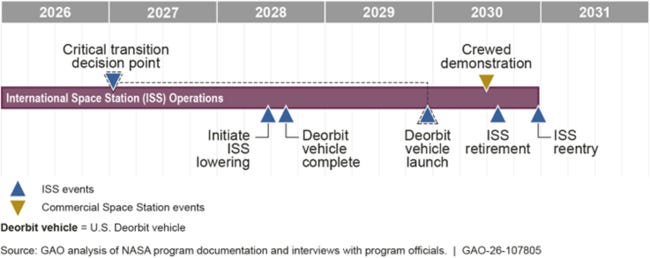
Figure 1: A tentative ISS de-orbit plan. NASA is still at the critical transition decision point. Source: GAO.
Ensuring human safety will likely turn out to be challenging, however. NASA can certify a station for its own astronauts and impose requirements. And the FAA regulates commercial launch and re-entry, although its authority over the safety of private spaceflight participants remains limited. In the commercial space sector, however, even if NASA becomes one customer among several, it won’t be an ordinary customer. The technical requirements and safety standards will still set the bar against which other stations are judged and which investors and allies regard as credible.
Tiangong and the Battle for Orbital Influence
Since the start of the century, the ISS has maintained a continuous crewed presence in low Earth orbit (LEO), always including American participation. De-orbiting and replacing the ISS risks creating a gap in continuous U.S. human presence in LEO, offering China an opportunity related to its Tiangong space station.
Tiangong is much smaller than the ISS, but has the advantage of being a more modern facility. And if the Chinese station could become the world’s only continuously crewed space station for a short period, this could make it a more attractive destination for international collaboration, research, and new technology development. This attraction is constrained, however, by concerns downstream of China’s authoritarian leadership, not least around transparency, security, and strategic alignment.
Here, it’s important to remember that in 2011, Congress passed the Wolf Amendment, which barred NASA and the White House Office of Science and Technology Policy from using federal funds to collaborate bilaterally with China. Note also, however, that private companies are not subject to the Wolf Amendment, although NASA-funded activities remain subject to appropriation restrictions.
Completed in 2022 and operated entirely by the state-run CMSA (China Manned Space Agency), Tiangong stands to benefit most directly from any delay in replacing the ISS. The longer it stands as the world’s only continuously crewed station, the easier it becomes for Beijing to portray its state-led model as more dependable than America’s market-driven one.
Comparing the American approach with the Chinese model isn’t a neat matter of private enterprise versus central control, however. In the case of commercial American space stations, NASA would still influence mission requirements, purchase services, and carry out qualifications and inspections. The U.S. government would, therefore, continue to shape the market — the real test being whether it does so through stable rules, competition, and institutional flexibility.
The New Terms of Space Cooperation
How NASA manages the transition towards the age of the private space station will shape the terms its allies face. On stability, NASA’s record has been a mixed bag. The agency has, over the past few months, moved from a commercially-led model to proposing a NASA-constructed core module, and then back again. Hence, the tennis. The good news is that these shifts signal NASA’s willingness to listen to the market and correct course. But they also send mixed signals to firms that are keen to plan their investments over the long term.
International cooperation will remain a part of the commercial space station paradigm, but there will be a lot more uncertainty. With national space agencies serving as anchor customers to private space companies, U.S. allies will find themselves in uncertain legal and economic positions.
Different commercial space station proposals have already accounted for allied participation. For example, Axiom Space, one of several companies in the commercial space station industry, has signed an MOU (memorandum of understanding) with ESA for scientific cooperation, including spaceflight operations and research opportunities involving ESA astronauts. The question here is: on what terms will allies participate?
By framing itself as a key anchor customer of the new space station era, NASA has the ability to influence financing. Partner agencies may gain more affordable access to commercial space stations. Domestically, NASA’s position as an anchor is also a signal that it aims to stimulate demand rather than own the market completely. However, the trade-off here is that partners may become more dependent on NASA’s procurement decisions, U.S. export control policies, and the financial performance of American companies. Moving away from the treaty-bound model could also lead to vulnerabilities. Such a level of American influence could expose allies to shifts in U.S. domestic space policy.
So, what options do allies have? According to European Spaceflight, ESA is reportedly soliciting studies for the feasibility of a Europe-led presence in LEO, potentially cooperating with Canada’s CSA and JAXA. This illustrates the classic autonomy-security dilemma in foreign policy: pursue strategic autonomy at a cost, or accept dependence and save money. For now, ESA is keeping its options open — commissioning a feasibility study while continuing to participate in U.S.-led platforms.
What’s next?
Should everything go well, NASA’s CLD program will become a case study for commercial space success. However, questions surrounding the international architecture need resolving before a new station is launched. NASA’s latest draft request for proposals is a step towards encouraging industry input and more dynamic public-private collaboration. Allied participation is as much a part of space station design as it is a diplomatic issue. The successor to the ISS may be privately owned, but access and cooperation will remain unavoidably geopolitical.
I like the way this piece keeps the politics attached to the commercial-station question. A privately owned station would not make low Earth orbit nonpolitical. Access, safety standards, partner rights, national prestige, and dependence on U.S. procurement would all still matter.
One thing I would add is that “space tourism” may be the wrong way to think about one possible private cash-flow source.
Tourism sounds like rich people buying an expensive vacation. That may happen, but I doubt it is the stronger mechanism. The more interesting category is sponsored orbital adventure: people willing to take real personal risk, with nations, sponsors, media companies, universities, foundations, or patrons willing to attach money and meaning to that risk.
Society has always had a powerful appetite for adventure. We support climbers, explorers, solo sailors, test pilots, astronauts, endurance athletes, and people who go first into dangerous places. The person taking the risk is the visible figure, but often the money comes from institutions that want to be associated with the story. That distinction matters. The paying customer may not be the flyer.
If SpaceX gets to real launch scale, this could become more than a one-off stunt economy. Lower launch cost and higher cadence would not make human spaceflight cheap or safe, but they could make it repeatable enough to package: selection, training, launch, the mission, return, documentary coverage, national pride, charitable causes, student experiments, corporate sponsorship, and scientific side projects.
That is not space tourism in the casual sense. It is closer to buying participation in the next human frontier.
I am more skeptical that ordinary science will carry the commercial station business. Science on Earth is vastly cheaper, easier, safer, and faster. Some microgravity work may be genuinely useful, and some research will be worth doing because Earth cannot reproduce the same conditions. But I would not expect basic science or speculative manufacturing to be the main revenue stream. At best, I see science as a secondary layer: useful, legitimizing, and sometimes valuable, but not the thing that pays the fixed cost of a station.
Reality check: this is speculation, not a forecast. The business would need paying missions again and again, with enough money left after launch, training, safety, insurance, station operations, and all the other costs. So I would not claim that sponsored orbital adventure will pay for commercial space stations. The more careful claim is that it may be one of the few private revenue streams with enough human appeal to matter.
Whether that becomes steady cash flow is the question.
By M. Raige — written by Mike Randolph and ChatGPT in one Sol session; AI-collaborative writing directed and reviewed by Mike Randolph. Mike loves space exploration and appreciates the work you are doing.